Are condoms needed in the bunker?
Sweden is arming itself for crisis and war, yet knowledge of sexual rights in emergency preparedness is still in its infancy, even though things are moving in the right direction. »Abortion is a total defense issue« says the Swedish Civil Defence and Resilience Agency (MCF), and menstrual products and condoms are to be provided in bomb shelters. However, the women’s shelter in Kumla criticizes the silence surrounding sexual violence.
When Ulrika Haraldsson opened the brochure If Crisis or War Comes (Om kriget eller krisen kommer), she searched in vain for information about sexual violence. The only thing she could find connected to sexual and reproductive health and rights (SRHR) was a tip to keep menstrual products at home.
»The fact that there isn’t a single line about sexual violence in the crisis brochure is—from a feminist perspective—a betrayal. We know that sexual violence increases during war; we have seen this in the former Yugoslavia, Ukraine, and the Democratic Republic of the Congo, among other places. So where is that preparedness?«

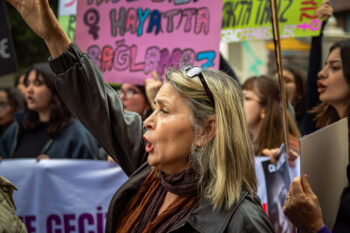
The chairperson of Svea Women’s Shelter in Kumla describes a compact silence—a monumental lack of interest in talking about these issues.
»Are people afraid of scaring the public? Or is it simply that men’s violence against women is ignored when a larger threat looms?«
At Svea Women’s Shelter, they tried to take matters into their own hands and applied for funding from the Swedish Gender Equality Agency to produce an alternative brochure specifically aimed at women—but were rejected.
»What we know from Ukraine, for example, is that women there are asking for emergency contraception (morning-after pills). You don’t want to give birth during a war. It is dangerous. And especially not if you have been subjected to sexual violence.«
»The fact that there isn’t a single line about sexual violence in the crisis brochure is a betrayal.«
Ulrika Haraldsson, Svea Women’s Shelter Kumla
An emergency kit should include morning-after pills, Ulrika Haraldsson argues—along with condoms and lubricant. She describes a scenario where one realizes there is a risk of being subjected to rape, potentially repeatedly, and how preparing for this can be a way to minimize the risk of physical injury and unwanted pregnancies.
»We also fear that healthcare services won’t prioritize this—that as long as you can walk and stand, you will be left to fend for yourself. That is why we need to spread knowledge on how to take care of one another after sexual violence.«
The Swedish Civil Defence and Resilience Agency (MCF, formerly MSB) is behind the crisis brochure that was first distributed to all households in 2018, and later in an updated version in 2024. Valter Vilkko works with social sustainability and gender equality at the agency.
”The brochure is the final product of a collaboration between many different actors. What I can say is that the issue of sexual violence was not entirely absent from the discussions, though I cannot answer why it wasn’t included,” says Valter Vilkko.
»Soldiers returning with traumatic experiences from war pose an increased risk of violence.«

He mentions a report produced by MSB in 2024 based on experiences from Ukraine for the Swedish total defense. It highlights that intimate partner violence has increased since the Russian invasion. Experiences from Hurricane Katrina in the US in 2005 and the major bushfires in Australia in 2009 also show that domestic violence tends to rise during crises, when people lose their homes and incomes and society is under pressure.
»We also know that soldiers returning with traumatic experiences from war represent an increased risk for violence,« says Valter Vilkko.
Yet sexual violence is only one part of the picture. Preparedness to ensure access to sexual and reproductive health and rights during crisis and war also involves conditions for safe sex, maternity care, sex education, HIV medication, and abortion care.

Sexuality and reproduction are not put on pause, neither during war nor other crises—which can become protracted. But is this a self-evident part of Swedish emergency preparedness as it looks today?
»Both yes and no,« says Valter Vilkko, continuing: »Those working in emergency preparedness are open to the knowledge. It is not the same situation as just six years ago, when we conducted the first major total defense exercise since the 1980s. Back then, the level of knowledge regarding SRHR was lower.«
Still, knowledge remains limited, he notes. Valter Vilkko shares that he has raised the SRHR perspective in around ten workshops with Sweden’s county administrative boards, and that the agency worked with the issue during the 2020 total defense exercise. SRHR is also included in the agency’s guidelines on how municipalities can design special »safety points«.
»We also don’t want people crossing borders to get abortion care.«
Valter Vilkko, MCF
Abortion is a total defense issue, Valter Vilkko states. It cannot be ignored in the mission to protect human life and health—both mental and physical.
»We also don’t want people crossing borders to get abortion care, or resorting to illegal abortions,« he says.
He cites the UK and France during the pandemic as examples. In both cases, authorities were forced during an ongoing crisis to change regulations to allow at-home abortions via digital healthcare consultations. In the UK, the equivalent of the Parliamentary Ombudsman initially blocked the regulatory change before it was finally implemented.
»You have to look around the corner and prepare for what happens when healthcare can no longer be accessible in the usual way. In those situations, there must be an option to have an abortion without visiting a healthcare facility,« says Valter Vilkko.
That is not how it works in Sweden today. Currently, an initial in-person medical visit is required to start an abortion, which can then be completed at home. However, this may change: a 2025 government inquiry proposed allowing abortions to take place without that initial physical appointment.

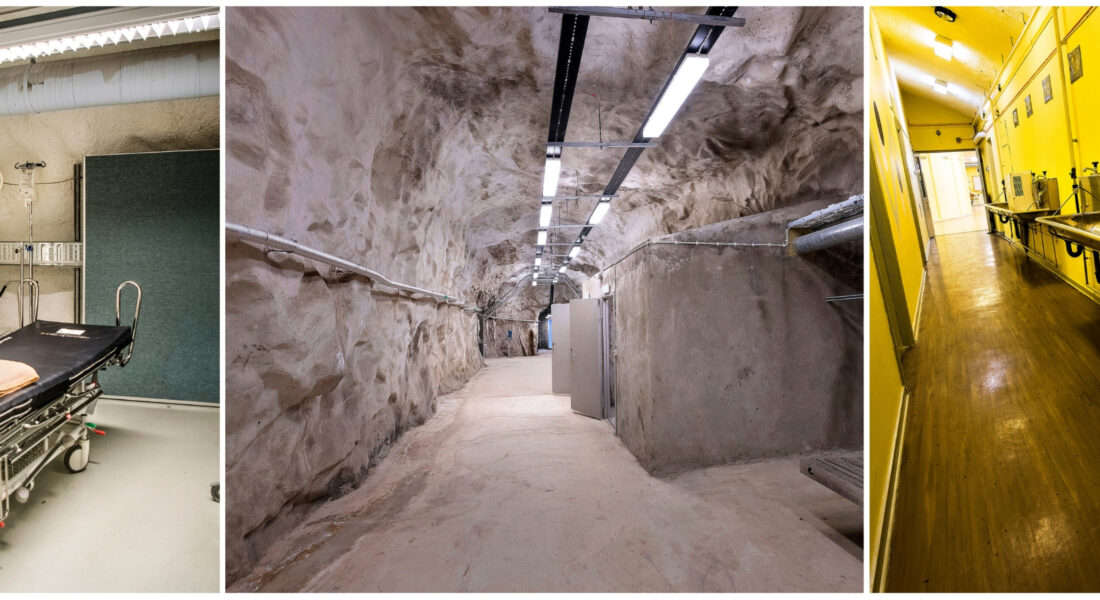
Accommodation at the Civil Defence main command centre, HC Eslöv. Credit Richard Dahlgren, Fortifikationsverket väst.

Society is meant to continue functioning as far as possible during war and crisis; that is the foundational principle. Responsibility for SRHR issues is distributed according to the same principle as in peacetime across government agencies, healthcare facilities, schools, and other institutions. At the National Board of Health and Welfare (Socialstyrelsen), work is underway to define what constitutes ”»care necessary for life and health« following a government assignment.
»In short, the basic premise is that this concerns illnesses and injuries that, even with a short delay, could pose serious risks to the patient,« explains Bruno Ziegler, medical expert at the National Board of Health and Welfare who is leading the project.
However, it will not be until January 2027 that the board presents its interpretations of what is essential for life and health—the care that must be provided even during war and crisis, and what can therefore be deprioritized. In the government’s directive, maternity care is specifically mentioned, whereas abortion care is not.
»It states that it must concern life-threatening conditions and those that can lead to permanent disability. Contagious diseases falling under the Communicable Diseases Act are also included. We cannot say anything more specific about the interpretations yet.«


The Public Health Agency of Sweden (Folkhälsomyndigheten) is also tasked with compiling a list of medications required to provide care that cannot be deferred. This work builds on two previous lists of critical medications produced by the agency. On the first, shorter list, medications for abortion and HIV treatment are missing. They are, however, included on the second, longer list. Hormonal contraceptives and medications for menopausal symptoms are not included on either list.
»We are taking a fresh look at this now, though the previous lists give an indication,« says Bruno Ziegler.
Is a gender perspective included in these assignments given to the National Board of Health and Welfare?
»It is not. However, the board’s project model includes monitoring various perspectives.«
Have you done so in these cases?
»The gender perspective specifically is not explicitly stated in this work.«
Ottar has contacted several actors to get an overview of SRHR within emergency preparedness. When asked where and how childbirth is planned to take place in the event of war, Region Stockholm responded: ”Planning for heightened alert is ongoing across all healthcare areas. Naturally, there will be designated locations for how maternity care will be handled in such a situation, but we cannot go into further detail than that.”
How are authorities working to ensure access to condoms, and thus protection against unwanted pregnancies and sexually transmitted infections? The Public Health Agency of Sweden refers to the regions. Region Skåne replies that a general tip is to stock your emergency kit with condoms and keep an eye on expiration dates, adding: »We do not supply the population with condoms in peacetime, nor are there plans to do so in wartime.«

Swedish Agency for Defence Analysis (Myndigheten för totalförsvarsanalys) writes that there are currently no plans to examine how SRHR and gender perspectives are accounted for as total defense expands: »No, we have not conducted—nor do we plan to conduct—any analysis or evaluation of the kind you mention. Nor am I aware of any government assignment to an agency with that focus,« replies Joakim Sonnegård.
Region Västra Götaland states the same thing—they hold no responsibility for providing condoms. However, both regions state that their work on sexual health will continue as far as possible even in times of crisis. Region Stockholm maintains a list of items considered extra critical during crisis and war; condoms are Swedish Agency for Defence Analysis on that list.

Maria Engberg is an emergency preparedness coordinator in Härnösand Municipality. She has worked from a rights-based perspective since she started just over three years ago.
»When I came in, I felt something was missing—that we don’t talk enough about people and their differing needs and circumstances.«
Maria Engberg emphasizes that a lot of good work is being done in emergency preparedness, but that there is room to develop efforts rooted in human rights, including highlighting the vulnerability of exposed groups.
Demand for increased resources has grown markedly since the war in Ukraine began. The field has »exploded,« as Maria Engberg puts it.
»Money is coming in, mostly in the form of earmarked grants, primarily to government agencies and then to municipalities.«


More resources for municipalities are expected via state grants, though the exact amounts and how they will be used remain to be seen.
Is there a clear gender perspective in your preparedness mandate?
»Both yes and no. The protected values we work from include life and health, but also democracy and human rights. So the rights perspective is there, though only in a single sentence.«
She describes rights-based work as a prerequisite for developing all other preparedness efforts. She views municipal safety points—gathering places municipalities can establish to support people during crises, heightened alert, and war—as a concrete example of where rights-based civil preparedness can be put into practice. At these safety points, people should be able to gather for information, warmth, phone charging, and coffee.
»Previously, people often thought in terms of ’a roof over your head and four walls,’ but that isn’t enough. That has become clear, largely based on experiences from Ukraine,« she says, continuing:
»We do not supply the population with condoms in peacetime, nor are there plans to do so in wartime.«
Region Skåne
»We need to think about safety on the inside as well, so to speak. How do we think about women and men when we gather groups together? Ethnic background and religion are additional aspects here. We may also have LGBTQI+ individuals who feel unsafe around shared toilets and shower facilities.«
It is about viewing safety and accessibility in a broader sense, Maria Engberg explains. In the checklist developed by the Swedish Civil Contingencies Agency for safety points, the need for breastfeeding spaces and ensuring that »women’s sanitary needs are met« are also highlighted.
Another example Maria Engberg raises is setting up public water tanks during emergencies.
»You have to look at different groups and ask questions like: Does everyone have the ability to get there? Who has a car? What does it look like for those living in violent relationships with a controlling partner? If we conclude that no, not everyone is able to get there, what measures do we need to put in place?«
Just like Ulrika Haraldsson at Svea Women’s Shelter in Kumla, Engberg also brings up sexual violence.
»We know from experience that sexual violence increases during war and crisis, and we have no reason to believe it would be any different here. So how do we work preventively? How do we equip people for it? These are questions we are starting to raise now, but the work is still in its infancy.«
Anna Dahlqvist is a freelance journalist.